
Solid vs. engineered hardwood: choosing a floor for mountain living.
Both can look exceptional in a luxury home. The better choice depends on the indoor environment you can maintain, the floor’s construction, and the way the property is used—not simply its elevation.
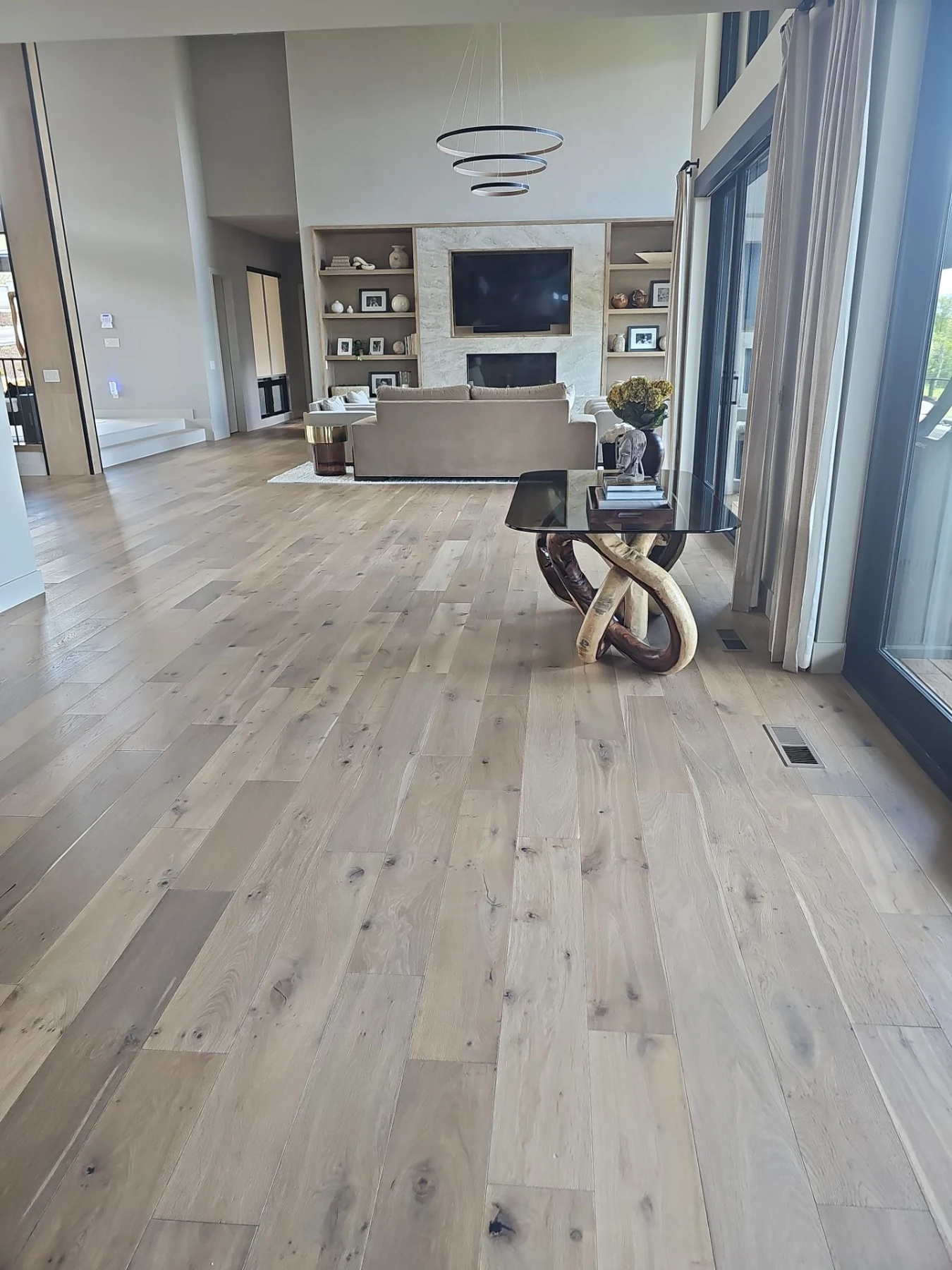
In Park City, Deer Valley, Kamas, and other northern Utah mountain communities, a wood floor has to suit more than the design palette. Long heating seasons, changing occupancy, and indoor humidity management belong in the selection conversation. A beautiful sample is only the beginning; the floor must also fit the building and its maintenance plan.
First, engineered hardwood is real hardwood.
Solid hardwood is milled from a single piece of wood. Engineered hardwood has a real hardwood surface bonded to a layered core. It is not the same thing as laminate or luxury vinyl. Its construction generally improves dimensional stability, meaning it tends to move less as conditions change. That does not make it immune to moisture problems.
| Consideration | Solid hardwood | Engineered hardwood |
|---|---|---|
| Construction | Wood through the thickness of the plank. | Real hardwood surface over a layered core. |
| Humidity changes | Typically more movement; species, cut, and width matter. | Generally more stable; product limits still apply. |
| Future refinishing | Often offers substantial renewal potential, depending on remaining usable thickness and condition. | Depends on the wear layer, construction, and manufacturer; some cannot be sanded. |
| Concrete or radiant heat | Do not assume compatibility. | Some products are approved; check the exact system. |
| Luxury appearance | Authentic wood grain and many finish options. | Authentic wood surface and many finish options. |
Judge the actual board, not only the category name. Two engineered products can have very different wear layers, warranties, and installation requirements. Likewise, solid flooring varies with species, cut, finish, and plank dimensions.
High elevation matters through the home’s indoor conditions.
Altitude alone is not a flooring specification. In a cold mountain setting, heating outdoor air can leave the indoor air very dry unless moisture is managed. The important measurements are the conditions at the floor: indoor relative humidity and temperature, flooring moisture content, and the subfloor’s condition.
Wood exchanges moisture with its surroundings. Dry conditions can produce shrinkage, gaps, or splits; added moisture can cause swelling. The National Wood Flooring Association also notes that some engineered floors can develop dry cupping during dry winter conditions. Engineered construction reduces certain movement risks; it does not remove the need for a suitable environment.
For a second home or vacation property, plan for the weeks when no one is there. A humidity strategy that depends on a guest remembering to fill a portable humidifier is different from a monitored, maintained system. Our practical recommendation is to choose a product whose published limits match the conditions the property can sustain while occupied and vacant.
A humidifier can help—but more humidity is not always better.
Use a hygrometer to measure indoor relative humidity rather than guessing from how the room feels. NWFA offers 30–50% relative humidity as general care guidance, but that is not a universal setting or a substitute for the flooring manufacturer’s written limits. Select the floor around a climate range that the building can safely maintain.
A humidifier should be sized, controlled, and serviced appropriately. Have the HVAC plan reviewed alongside the flooring choice, especially in a house with large windows, multiple levels, or variable occupancy. A sensor near a supply register may not reflect conditions throughout the home, so compare readings in the actual living areas.
Cold windows and other cold surfaces can collect condensation when indoor moisture is too high for the conditions. Raising the humidifier to satisfy a floor’s minimum humidity may therefore create another building problem. Persistent interior condensation deserves investigation; do not keep increasing humidity to chase a flooring target.
If the home cannot maintain the product’s required range without condensation or other moisture problems, reconsider the flooring specification or address the building conditions before installation. Do not rely on a humidifier to correct a leak, damp slab, or an unsuitable floor assembly.
Leaks from humidifiers and standing water are separate risks. Ordinary engineered wood should not be treated as waterproof. Use the manufacturer’s care instructions, contain spills promptly, and avoid placing a portable unit where it can repeatedly wet the floor.
Radiant heat, slabs, and acclimation need a product-specific plan.
Some engineered floors are suitable for radiant heat or concrete installations, but approval is specific to the product. Check the approved species, installation method, adhesive or underlayment, moisture protection, and temperature controls. “Engineered” on the carton is not sufficient authorization to install over any heating system.
For a radiant installation, follow the flooring and heating-system instructions together, including startup, temperature changes, and any floor-surface temperature limits. Do not apply one manufacturer’s limits to a different product. Resolve conflicting requirements before the floor is ordered.
Acclimation is also more than leaving boxes in the house for a set number of days. The manufacturer may specify how the material is stored, whether packaging stays closed, and which measurements determine readiness. The HVAC system and jobsite should reflect the intended occupied conditions, with flooring and subfloor moisture checked as required. Bruce’s acclimation guidance emphasizes that timing depends on the conditions and product.
Sequence wet trades and finish work thoughtfully so the floor is not introduced to temporary construction moisture. Record the product requirements and site readings, then give the owner a clear care plan. This is especially useful when a property manager will maintain the home after the renovation.
Which looks more elegant—and supports property value?
Either construction can support an elegant interior. Visual quality comes from species and grain selection, consistent transitions, appropriate plank scale, finish sheen, and the way the floor works with cabinetry, stone, paint, and stairs. A well-chosen engineered floor does not need to look less luxurious than solid wood.
For a refined mountain interior, consider a natural-toned oak with restrained sheen, or a richer wood palette that complements the home’s millwork. These are design directions, not universal rules. View a large sample in daylight and evening light, and compare the grade and color variation across several boards.
Solid wood may appeal to owners who prioritize future refinishing. A premium engineered option may better suit an approved radiant system or a wide-plank design. Refinishing potential should be verified in writing: wear-layer thickness, bevels, texture, previous sanding, and manufacturer restrictions all affect what is possible.
For property value, focus on condition, appropriate quality, and fit with comparable homes. Neither “solid” nor “engineered” guarantees a higher appraisal or a specific return. A floor that stays attractive and can be maintained is a stronger long-term choice than an impressive specification that does not suit the building. Ask a local real estate professional about buyer expectations for your property’s market.
Our approach: choose for the house you actually have.
For a mountain renovation with broad planks, an approved radiant system, or more demanding site conditions, a high-quality engineered product is often a sensible starting point for comparison. That recommendation depends on its written humidity range, wear layer, and installation approvals—not on a blanket promise that engineered wood solves dry air.
Solid hardwood remains worth considering where the installation is approved, indoor conditions are reliably controlled, and long-term renewal is a priority. If humidity cannot be maintained within either product’s limits, pause the selection and address that mismatch rather than assuming one wood construction will tolerate it.
- Measure the environment. Review seasonal humidity, heating, occupancy, and subfloor conditions.
- Compare the exact products. Check species, width, wear layer, warranty, and installation permissions.
- Coordinate HVAC and building needs. Account for humidification and condensation risk together.
- Approve the complete look. Review samples with trim, stairs, cabinetry, and adjoining floors.
- Plan ownership. Provide care instructions and realistic climate-control responsibilities.
At High Altitude Renovations, hardwood flooring is part of a coordinated renovation. We discuss how it relates to custom carpentry, paint and finish work, and the property’s ongoing use. Our HVAC S350 licensing also makes heating and humidity needs a natural part of the project conversation.
Technical references & further reading
These resources support the construction and moisture guidance. Follow the current installation, maintenance, and warranty requirements for the exact product selected. No manufacturer affiliation is implied.